OUR PHONE NUMBER: 828-764-3305 • 732-928-7973
Posters
Home » Posters
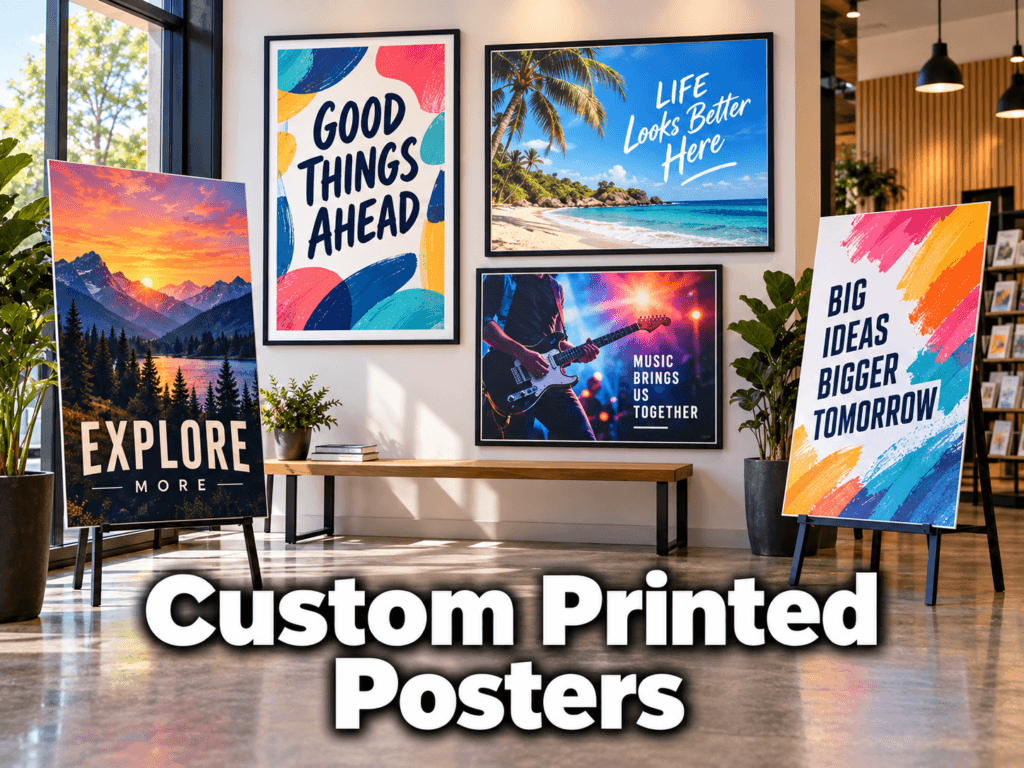
Why Choose Our Custom Printed Posters
- Vibrant, Full-Color Printing Rich colors, sharp images, and crisp lettering help your poster attract attention and communicate your message clearly.
- Professional Quality and Appearance Custom printing gives your posters a polished, professional look that reflects the quality of your business, organization, or event.
- Custom Sizes for Any Display Choose the poster size that works best for windows, walls, easels, retail displays, trade shows, presentations, or framed artwork.
- Perfect for Business or Personal Use Promote products, advertise events, display important information, decorate a space, or create personalized posters for special occasions.
- Professional Graphic Design Available Don't have print-ready artwork? We can create an eye-catching poster using your logo, wording, colors, photographs, and other design elements.
- Affordable, High-Impact Advertising Posters provide an economical way to reach customers, promote an event, or display your message in locations where people will see it.
- Local, Personal Service Highridge Graphics provides custom poster printing in Morganton, NC, and throughout Burke County. We also continue to serve our longtime customers in Jackson, NJ, and throughout Monmouth and Ocean counties.
Common Uses for Custom Printed Posters:
- Business Advertising – Promote your company, products, services, special offers, or important announcements with professional business posters.
- Retail Promotions and Sales – Highlight seasonal sales, new products, limited-time offers, and in-store promotions in windows or throughout your business.
- Events and Entertainment – Advertise concerts, festivals, performances, fundraisers, grand openings, and community events.
- Trade Shows and Presentations – Display product information, company branding, charts, photographs, and promotional messages at exhibits and presentations.
- Schools and Educational Displays – Create classroom posters, educational charts, school-event announcements, recognition displays, and student presentations.
- Churches and Nonprofit Organizations – Promote programs, services, fundraising campaigns, special events, and community outreach activities.
- Restaurants and Hospitality – Display menus, food photography, daily specials, upcoming events, and promotional offers.
- Real Estate and Property Marketing – Showcase properties, floor plans, development information, and open-house details.
- Photographs and Decorative Artwork – Turn photographs, illustrations, or custom artwork into attractive posters for homes, offices, lobbies, and public spaces.
- Personalized Posters – Create custom displays for birthdays, anniversaries, graduations, reunions, memorials, and other special occasions.
Custom Printed Posters
Our custom-printed posters are an affordable and effective way to promote your business, advertise an event, display important information, or transform photographs and artwork into impressive visual displays. With vibrant full-color printing, sharp detail, and crisp lettering, your message will look professional and attract attention.
Whether you need business posters, retail-sale posters, event posters, trade-show graphics, educational displays, or personalized posters for a special occasion, we can produce the size and quantity that fit your needs.
Request a free quote

Have questions? Call us at 828-764-3305
File Setup for Custom Printed Posters
To help your posters print accurately and look their best, please prepare your artwork using these guidelines:
- Color Mode – Create and save all artwork in CMYK color mode. RGB files will be converted to CMYK before printing, which may cause some colors to change.
- Resolution – All photographs and raster images should be at least 300 DPI at the final printed size for sharp, professional results.
- Document Size – Build your artwork at the exact finished poster size. Do not enlarge a smaller design to the final size without checking the image resolution.
- Bleed – Add 0.125″ (1/8″) bleed on all four sides. Background colors, photographs, and other elements that extend to the edge must continue completely through the bleed area. For example, an 18″ × 24″ poster should have an artwork size of 18.25″ × 24.25″ with bleed included.
- Safe Area – Keep all important wording, logos, borders, and critical design elements at least 0.25″ inside the finished trim edge.
- Preferred File Format – We recommend submitting a print-ready PDF/X-4 file. High-resolution JPEG, TIFF, EPS, and Adobe Illustrator files may also be accepted.
- Fonts – Convert all fonts to outlines or embed them before saving the final file. This prevents missing fonts or unwanted font substitutions.
- Images and Graphics – Embed all linked images and confirm that they are high resolution at the final printed size. Images copied from websites are often too low in resolution for quality poster printing.
- Large Black Areas – For deeper black backgrounds and large black areas, use a rich-black CMYK build of C60 M40 Y40 K100 rather than 100% black alone.
- Borders – Keep borders at least 0.25″ inside the trim line. Slight movement during cutting can make narrow borders appear uneven.
- Crop Marks – Please do not include crop marks unless specifically requested.
Need Help Preparing Your Poster?
- If you do not have print-ready artwork, Highridge Graphics offers professional graphic design and file-preparation services. Send us your wording, logo, photographs, preferred colors, and finished poster size, and we can create a professional design for you. A proof will be provided for your approval before printing.
Poster Materials
Choose the poster material that best matches the appearance, display location, and durability your project requires.
Which Poster Material Should I Choose?
8 Mil Photo Paper
Our 8 mil photo paper is an excellent choice when image quality and vibrant color are the priorities. Its smooth printable surface reproduces photographs, detailed graphics, gradients, and rich colors with a crisp, professional appearance.
Recommended for:
- Photographic posters and enlargements
- Artwork and decorative prints
- Retail and promotional displays
- Trade shows and presentations
- Event posters
- Posters displayed in frames
9 Mil Semi-Gloss Poster Paper
Our 9 mil semi-gloss paper provides a slightly heavier feel with a smooth, professional finish. The subtle sheen enhances color and detail while helping reduce the strong reflections associated with high-gloss surfaces. It is a versatile choice for posters containing both photographs and text.
Recommended for:
- Business and advertising posters
- Retail signs and point-of-purchase displays
- Event and promotional posters
- Educational and informational displays
- Trade-show graphics
- Posters displayed under bright indoor lighting
Choose 8 mil photo paper when photographs, artwork, and vibrant image reproduction are most important. Choose 9 mil semi-gloss paper when you want a slightly heavier poster with a balanced finish that works well for both images and easy-to-read text.
Both materials are intended primarily for indoor use. Posters displayed outdoors or in areas exposed to moisture should be properly protected or placed inside a weather-resistant display.
“Mil” refers to material thickness. One mil equals one-thousandth of an inch.
Ink Color
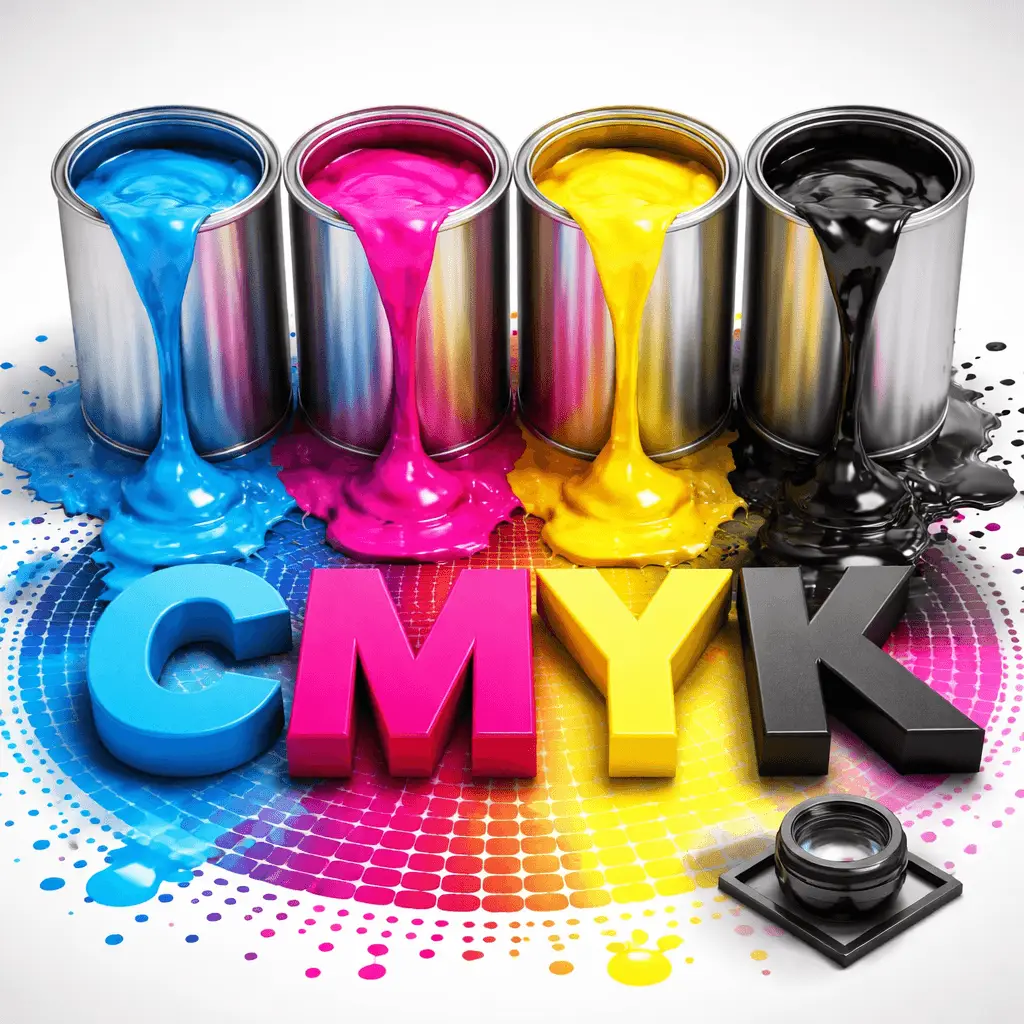
Our custom posters are digitally printed in full color using the CMYK printing process. Cyan, magenta, yellow, and black inks are combined to reproduce photographs, illustrations, logos, gradients, and a wide range of colors.
Vibrant Color and Sharp Detail
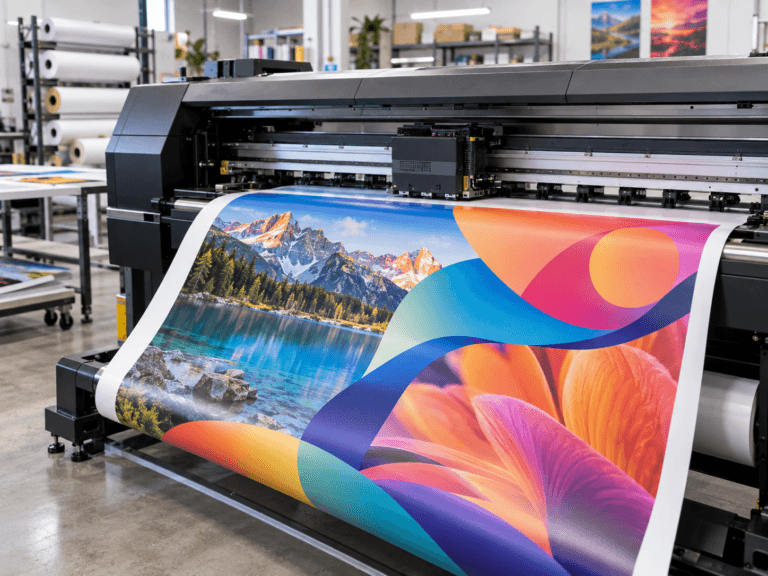
Our high-resolution printing process produces rich colors, smooth tonal transitions, crisp lettering, and detailed images on both 8 mil photo paper and 9 mil semi-gloss poster paper.
Full-color printing allows you to include photographs and multiple colors without being limited to one or two ink colors.
Preparing Colors for Printing
For the most accurate results, artwork should be created and saved in CMYK color mode. Files submitted in RGB will be converted to CMYK before printing, which may cause certain bright colors to appear slightly different.
Computer monitors and mobile devices produce colors using illuminated RGB light. Printed posters reproduce colors with CMYK inks, so the finished poster may not exactly match what appears on your screen.
White Areas
Our posters are printed on white material. Areas that appear white in your design normally receive no ink, allowing the white paper to show through.
Matching Brand Colors
If your business uses specific brand colors, include the appropriate CMYK or Pantone color information with your artwork. We will make every reasonable effort to reproduce your colors accurately, but exact Pantone matches cannot be guaranteed with CMYK digital printing.
Large Black Areas
For deeper, richer black backgrounds, use a rich-black build of C60 M40 Y40 K100 rather than 100% black alone. Small black text and thin black lines should generally use 100% black only for the sharpest reproduction.
Poster Lamination Options
Lamination adds a clear protective film to the printed surface of your poster. It improves
durability and helps protect the print from fingerprints, light scratches, dirt, and occasional
moisture.
Matte Lamination
Matte lamination provides a smooth, low-glare finish with a soft, professional appearance. It makes text and graphics easier to view under bright lights or near windows where reflections may be a concern.
Matte lamination can slightly soften colors and contrast, producing a more subtle and refined appearance.
Recommended for:
- Business and informational posters
- Trade-show and presentation displays
- Educational posters
- Posters containing a large amount of text
- Displays placed under bright indoor lighting
- Artwork requiring a sophisticated, non-reflective finish
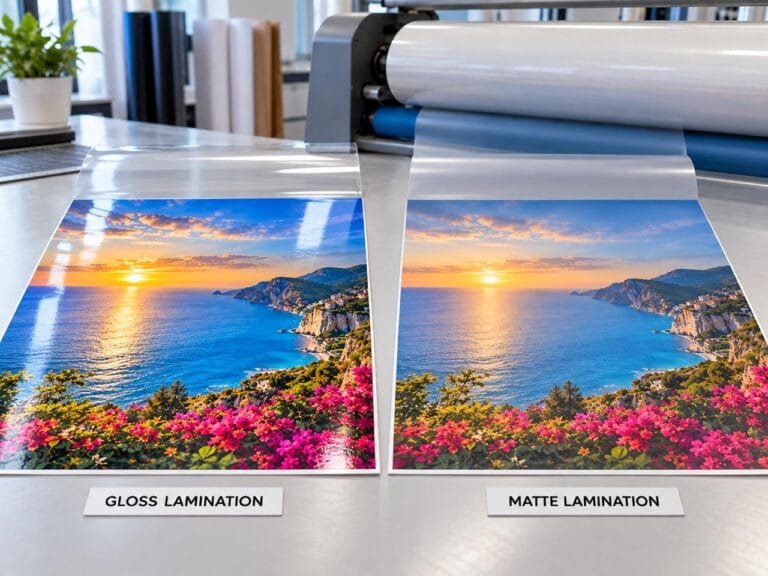
Gloss Lamination
Gloss lamination provides a shiny, reflective finish that makes colors appear brighter and photographs look more vibrant. It increases contrast and gives the poster a bold, polished appearance.
Because the surface reflects light, gloss-laminated posters may show more glare and fingerprints than posters with matte lamination.
Recommended for:
- Photographic posters
- Retail and promotional displays
- Food and product photography
- Event posters
- Colorful artwork and illustrations
- Posters where maximum color impact is desired
Which Lamination Should I Choose?
Choose matte lamination when reduced glare, readability, and a softer professional appearance are most important. Choose gloss lamination when you want stronger color, increased contrast, and a bright, eye-catching finish.
Lamination improves durability and moisture resistance, but it does not make a paper poster completely waterproof or suitable for permanent outdoor display.
Frequently Asked Questions About Custom Printed Posters
What poster sizes are available?
Custom posters can be printed in many different sizes. Popular sizes include 11″ × 17″, 12″ × 18″, 18″ × 24″, 24″ × 36″, and 27″ × 40″. Custom sizes may also be available. Contact us with the dimensions of your display area if you need help selecting the right size.
What poster materials do you offer?
We offer 8 mil photo paper and 9 mil semi-gloss poster paper. Both materials produce vibrant color and sharp detail but provide slightly different appearances and thicknesses.
What is the difference between 8 mil photo paper and 9 mil semi-gloss paper?
The 8 mil photo paper is an excellent choice for photographs, artwork, and designs where vivid image reproduction is the priority. The 9 mil semi-gloss material has a slightly heavier feel and a balanced finish that works well for posters containing both images and text.
Do you offer matte and gloss lamination?
Yes. Matte and gloss lamination are available for added protection and durability. Matte lamination reduces glare and provides a softer appearance, while gloss lamination makes colors look brighter and increases contrast.
Are your posters suitable for outdoor use?
Our photo and semi-gloss poster papers are intended primarily for indoor use. Lamination adds moisture resistance but does not make a paper poster completely waterproof. Outdoor posters should be placed inside a weather-resistant sign holder or protective display.
Can you print posters from my photographs?
Yes. We can turn high-resolution photographs into custom posters and enlargements. The photograph must have sufficient resolution for the requested poster size. We can review your image and let you know whether it is suitable for printing.
Do you provide poster design services?
Yes. Highridge Graphics offers professional graphic design services. Send us your logo, wording, photographs, preferred colors, and desired poster size, and we can create a professional poster design for you. A proof will be provided for your approval before printing.
What resolution should my poster artwork be?
Artwork and photographs should be at least 300 DPI at the final printed size for the sharpest results. Images downloaded from websites or social media are often too small for quality poster printing.
What file formats do you accept?
A print-ready PDF/X-4 file is recommended. We can also accept high-resolution JPEG, TIFF, EPS, and Adobe Illustrator files. Fonts should be converted to outlines or embedded, and all linked images should be included.
Does my poster artwork need bleed?
Yes. Add 0.125″ bleed on all four sides when colors or images extend to the finished edge. Keep important text, logos, and design elements at least 0.25″ inside the trim edge.
Will the printed colors match my computer screen?
Printed colors may look slightly different from colors displayed on a monitor or mobile device. Screens use RGB light, while posters are printed using CMYK inks. For the most predictable results, create and submit your artwork in CMYK color mode.
Can you match my company’s colors?
Include the appropriate CMYK or Pantone color information with your artwork. We will make every reasonable effort to reproduce your brand colors accurately, but exact Pantone matches cannot be guaranteed with CMYK digital printing.
Can the poster be placed inside a frame?
Yes. Posters can be displayed in standard or custom frames. Let us know the exact opening size of your frame so the poster can be produced at the correct dimensions.
How much does a custom poster cost?
Poster pricing depends on the finished size, material, quantity, lamination choice, and whether graphic design services are required. Request a free quote with your specifications for accurate pricing.
How long does poster printing take?
Production time depends on the poster size, quantity, finishing options, artwork readiness, and current workload. If you need your posters for a specific event or deadline, include that date with your quote request.
Will I receive a proof before printing?
A digital proof is provided when Highridge Graphics creates or adjusts your artwork. Carefully review all wording, spelling, contact information, dimensions, and layout before approving the proof.
How should I store and care for my posters?
Handle posters with clean, dry hands and avoid bending or folding them. When not displayed, roll the poster carefully with the printed side facing outward and store it in a protective tube. Keep unlaminated posters away from moisture and direct sunlight.